Tower
Crash

How Tower Works: Choosing a Risk Level and Cashing Out

by InOut Games

RTP
95.00%
Risk level
—
Top win potential
9,277,343x
Reels
—
Paylines and ways
—
Release date
24/09/2021

Tower’s quiet 20000 USD cap distorts its ladder, one padlock pick wipes banked

Tower's rules card sets a hard ceiling of 20000 USD on any single round, and that one printed number quietly rewrites all four ladders. The High risk table tops out at x9277343.75 on hit 10, a rung no legal stake can reach, since even at the maximum 200 USD bet the cap bites by hit 3, while in Medium it binds from hit 6. What remains is the part that behaves exactly as advertised. After five clean rows in Classic risk the cash-out read 8.67; the next pick opened a padlock, and the balance sat at 999990.22 before and after, the entire running total gone in one click. Each row ends with the same decision, bank the amber figure or stake it again on odds that shift with the risk mode, and Tower keeps that decision honest even where its own ceiling is not.

Tower Review: The Ladder Prints Millions, the Cap Decides

A ceiling the ladders never mention

The most consequential number in Tower never appears on its ladders. It sits in a help popup behind a small gear icon, printed as one flat line: Max win: 20 000 USD. That ceiling applies to every round, in every risk mode, at any stake, and it quietly rewrites the paytable the rest of the screen advertises. At the maximum bet of 200 USD the cap begins to bite inside High risk as early as hit 3, where x118.75 would nominally pay 23 750 USD, so everything above that rung is paid as 20 000 USD. The printed hit 10 rung of x9 277 343.75 is unreachable at every legal stake; it is a multiplier the build can display but never honour. Released on 24 September 2021, Tower still shows a nine-digit prize its own rules disallow, and the interface offers no hint of the truncation as you climb.

State you can read at a glance, in three panels

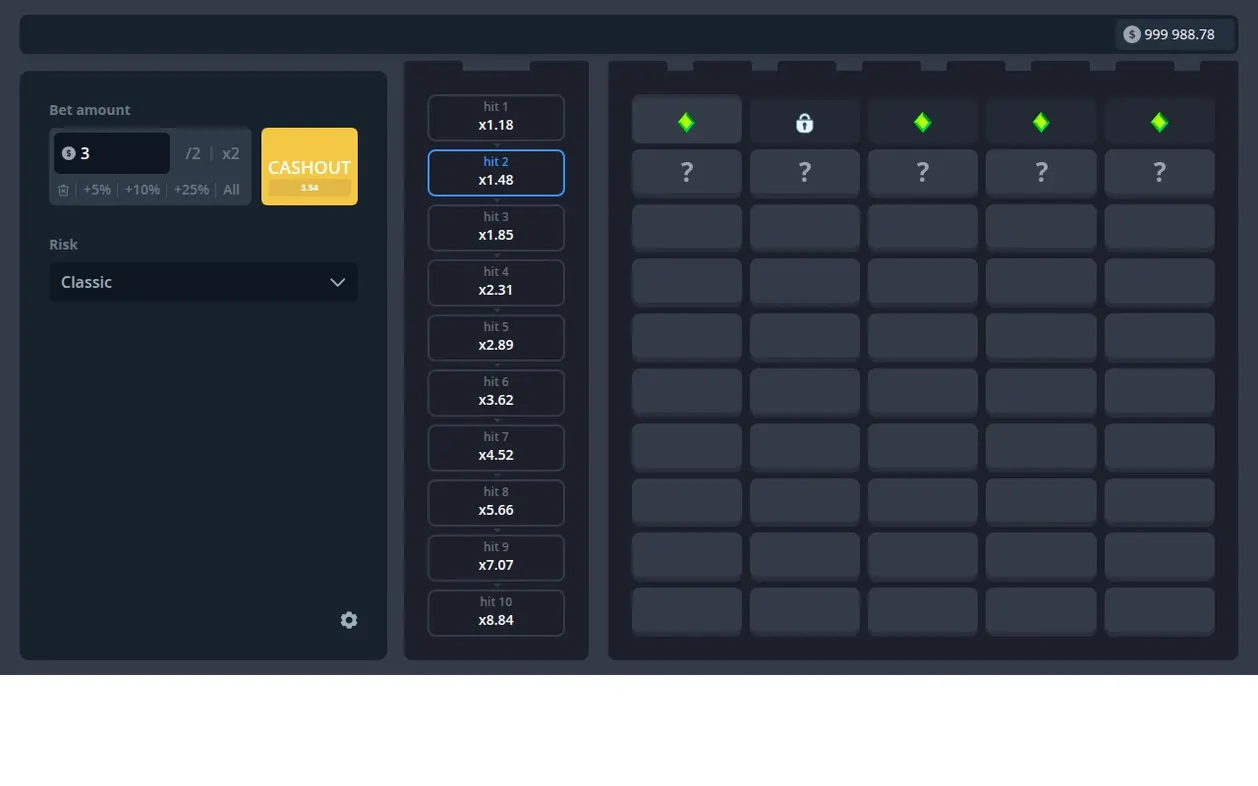
During a round the build is unusually explicit about where you stand. The ladder panel always displays the complete table for the active risk mode, and the rung just reached keeps its place with a blue outline, so the next multiplier stays visible in context rather than replacing what came before. The main button changes its label and its printed value, not just its colour: green BET becomes amber CASHOUT once a row is cleared, with the bankable amount printed underneath, such as 3.54 after a 3 USD stake survives hit 1 in Classic risk. Each pick resolves at once and reveals all five cells of that row simultaneously, so you see precisely where the padlock sat, including in cells you avoided. When the round ends, by cash-out, by lock or by reaching hit 10, the entire 10x5 board opens in one step and your path remains in a lighter shade against the full trap layout. At no point is your position ambiguous.

Classic risk round mid-play: row one reveals a lock, cashout ready at hit 2 for 3.54.

What the interface declines to disclose

The same build that narrates every state change stays silent on the numbers that generate them. RTP appears nowhere in the game or its rules popup, though the documented figure is 95.00. The per-row safe and trap split is directly observed only for Classic risk, at four safe cells out of five, and Medium risk, at two out of five. For Low risk and High risk, no captured board and no rules text states the ratio, so two of the four ladders climb on undisclosed odds. There is no provably-fair panel, no bet history, no autoplay and no loading screen. The single gear popup, holding four help steps, a sound toggle and the three limit lines of Min bet 0.12 USD, Max bet 200 USD and Max win 20 000 USD, is the entire information surface. The build even omits any studio wordmark or footer credit, an unusual choice for a release from InOut Games.

Four ladders, two of them half-documented

Modehit 1hit 10Per-row survival
Classic riskx1.18x8.8480%, 4 of 5 cells safe
Low riskx1.58x157.11not documented
Medium riskx2.37x9059.940%, 2 of 5 cells safe
High riskx4.75x9 277 343.75not documented

Who this tower suits

Players who track a running multiplier and want their current position spelled out will find Tower a notably legible pick-and-climb build. Every step is marked twice, by the blue ladder outline and by the value printed under the button, and the full-board reveal at the end closes the information loop. Players who compare titles on disclosed odds will notice that half of the modes ask them to climb without a published cell split, and that the headline ceiling is a printed figure the 20 000 USD cap makes unreachable. Round pace is instant, with no splash screen and no autoplay to wait on or hide behind, and audio can be muted entirely. It is a clean, fast ladder that shows you exactly where you stand, while keeping the arithmetic of the climb to itself.

Step-by-step guide to playing

Tower from InOut Games turns a single stake into a run across a 10-row board of five cells. Pick a cell, bank the growing amount with CASHOUT, or press on and risk the round on the next row.

  1. Start the round

    With the bet amount already inside the allowed range, press BET; if you want a different stake or difficulty, edit the amount or use the Risk dropdown first, then press BET. The round starts at row 1 with the board ready for a cell pick.

  2. Pick one cell in the active row

    Choose any one of the 5 cells in the current row. The game reveals all five cells at once: a diamond moves the ladder to the next hit and shows the bankable amount under CASHOUT, while a padlock ends the round and forfeits the accumulated amount.

  3. Bank or climb again

    After a diamond, either press CASHOUT to collect the shown amount and put the action button back to BET, or choose a cell in the next row and repeat the same reveal. A padlock at any point reveals the board and closes the round with no payout; clearing hit 10 also completes it.

Bankroll management and volatility explained

Tower leaves only three levers with documented consequences: the mode chosen before BET, the moment to stop after a diamond, and the stake size against a fixed 20,000 USD round cap. The records support Classic and Medium row mixes, an observed forfeit of a shown 8.67, and cap math; they do not verify Low or High mixes.

  1. Pick the risk mode before the round

    The Risk selector is available on the bet panel before BET, and the captured states do not show it being revised mid-round. Choosing Classic or Medium changes the ladder and the observed row mix: four diamonds against one padlock in Classic, two diamonds against three padlocks in Medium. Low and High ladders were captured, but their diamond/padlock mixes were not.

  2. Cash out or put the run back at risk

    After a diamond, CASHOUT prints the bankable amount and, if pressed, returns the action to BET. Picking the next cell instead leaves that amount at stake for one more reveal. The forfeit record makes the cost concrete: a Classic run with 8.67 showing ended on a padlock, and the balance matched the pre-pick balance rather than paying the accumulated amount.

  3. Size the bet against the payout cap

    The stake has to stay inside the documented 0.12 to 200 range to start a round. That choice sets the nominal payout, while the rules cap a round at 20,000 USD. At a 200 stake the cap equals 100x: High and Medium rungs above that can pay no more than the cap, whereas the whole Classic ladder stays under it. Where the cap bites depends on both stake and mode.

In-game screenshots

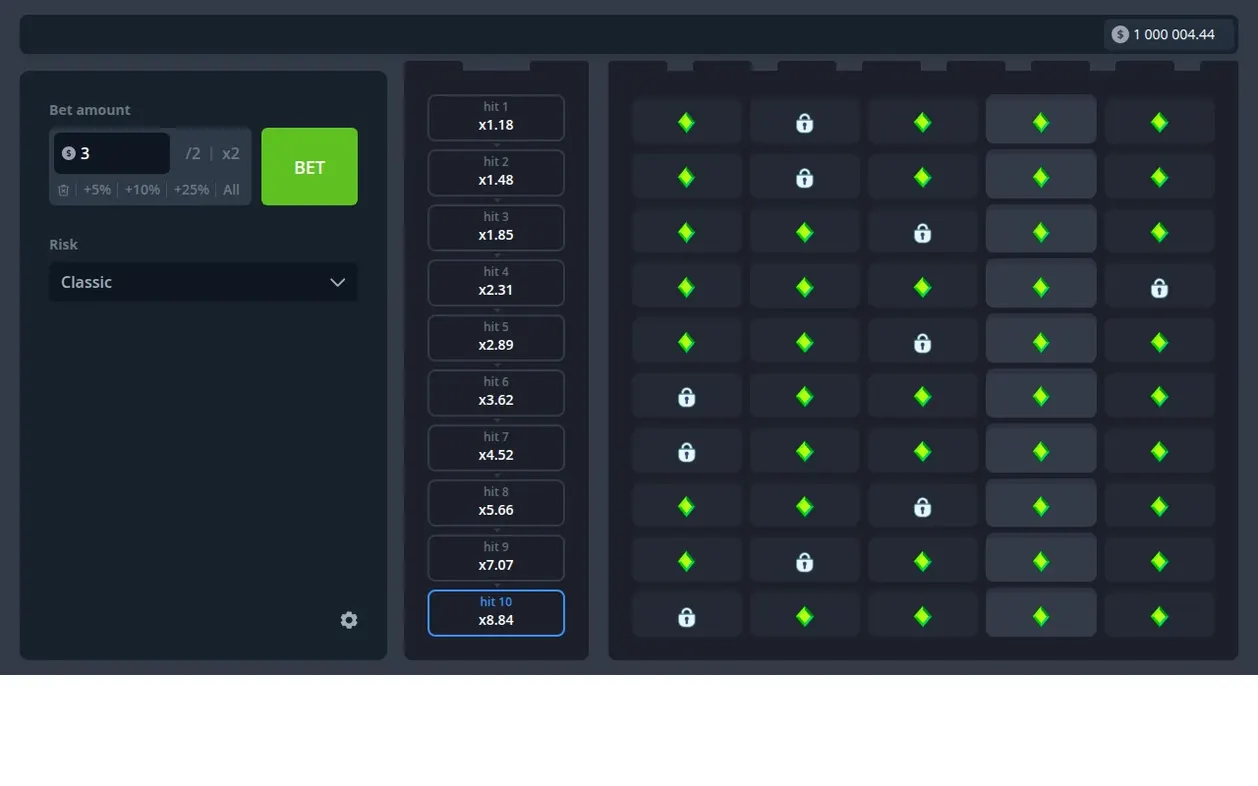
Full Classic risk grid shown after clearing all ten rows, hit 10 paying x8.84, balance 1 000 004.44.
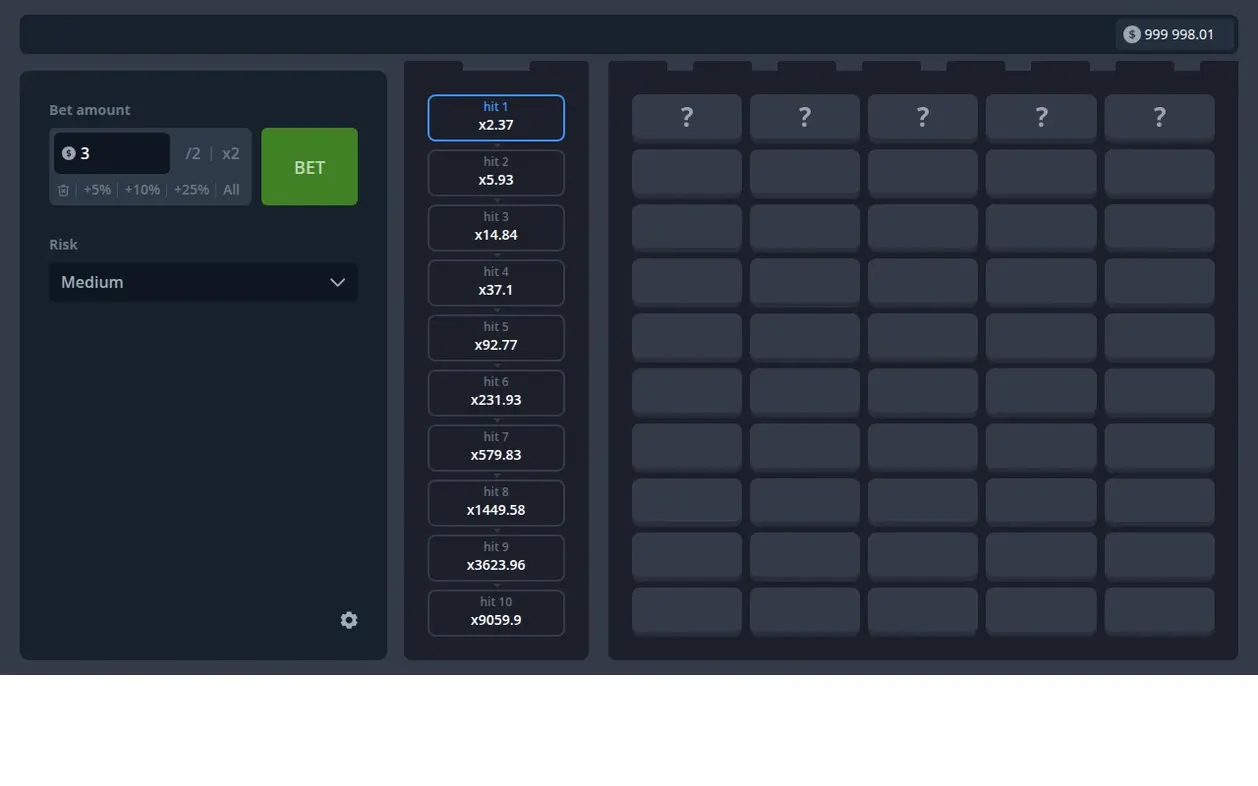
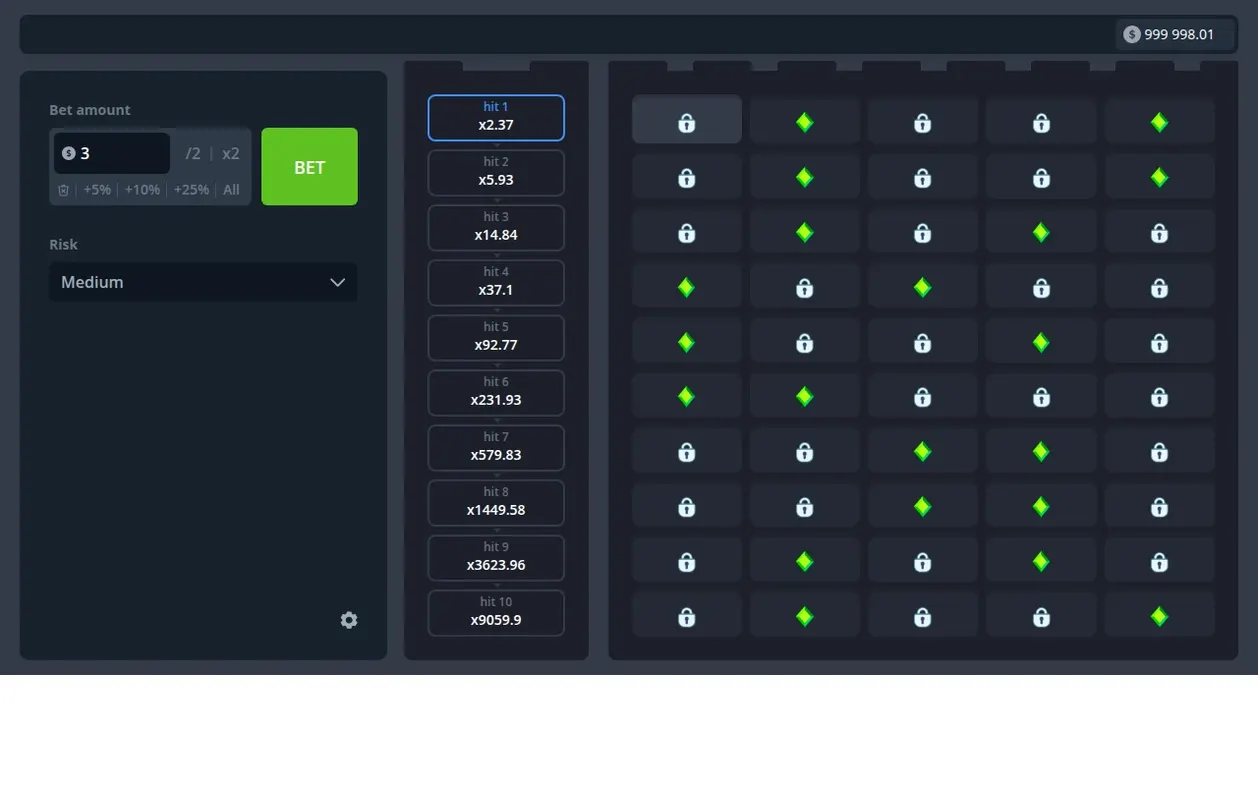
Idle Medium risk grid before a new round, hit 1 highlighted at x2.37, balance 999 998.01.
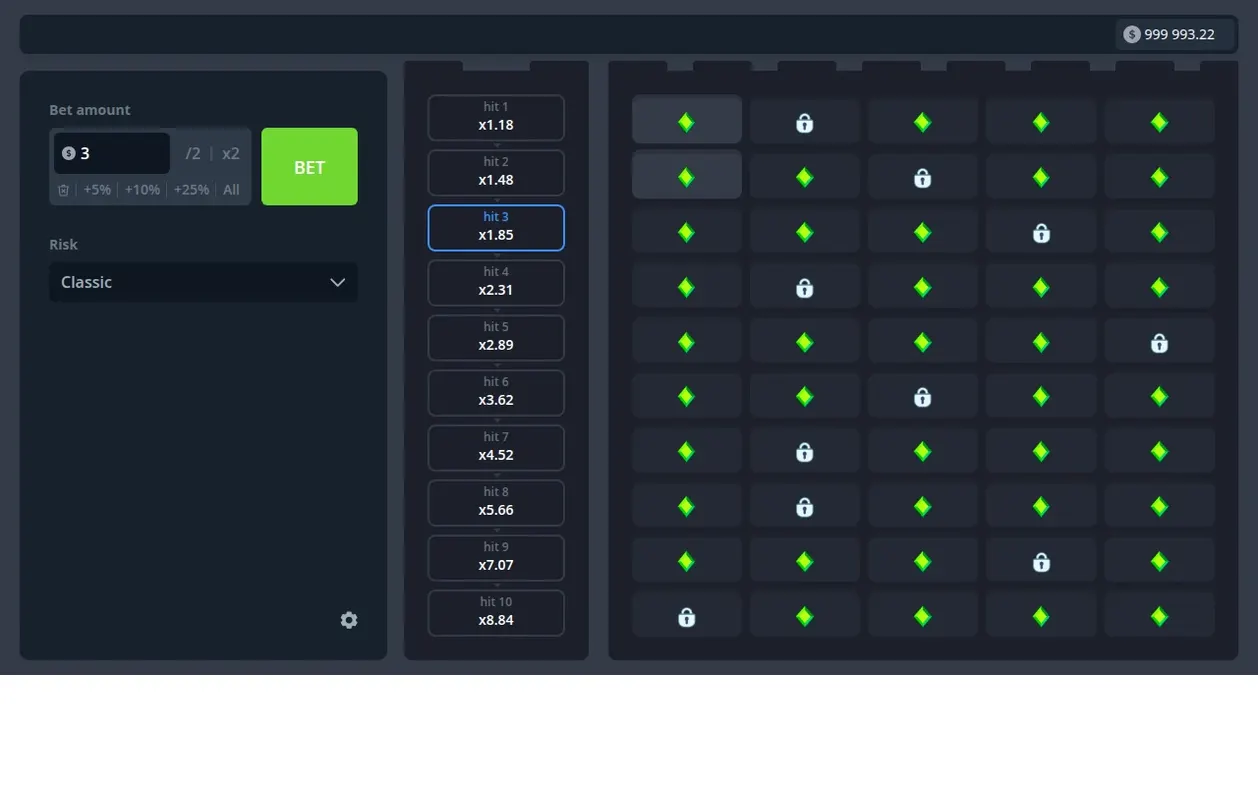
Full Classic risk grid shown after a hit 3 cash-out at x1.85, diamonds and locks filling every row.
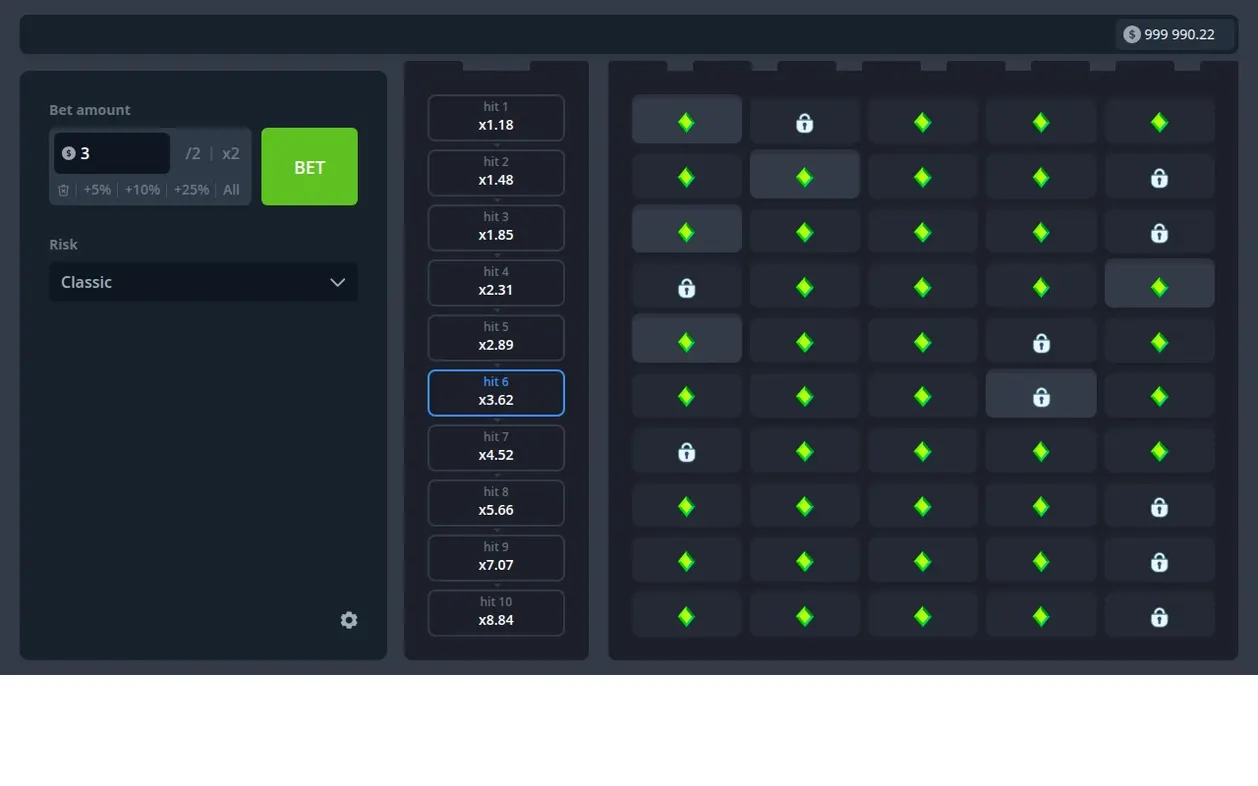
Classic risk loss at hit 6: the accumulated win is forfeited after hitting a lock, balance 999 990.22.
Medium risk board revealed after an instant loss on the first row, balance 999 998.01.
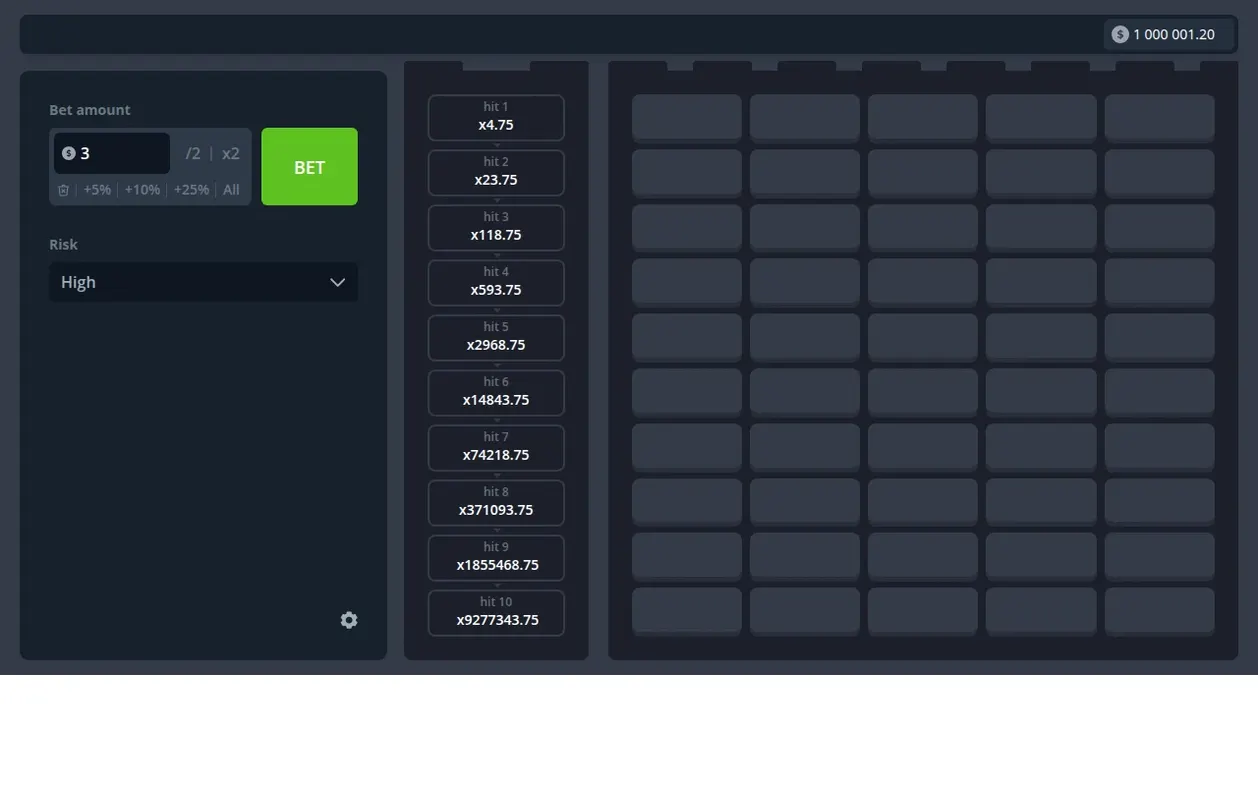
High risk idle grid before betting, ladder climbing from hit 1 x4.75 to hit 10 x9277343.75.
×
Full Classic risk grid shown after clearing all ten rows, hit 10 paying x8.84, balance 1 000 004.44.
‹1 / 6›
×
Idle Medium risk grid before a new round, hit 1 highlighted at x2.37, balance 999 998.01.
‹2 / 6›
×
Full Classic risk grid shown after a hit 3 cash-out at x1.85, diamonds and locks filling every row.
‹3 / 6›
×
Classic risk loss at hit 6: the accumulated win is forfeited after hitting a lock, balance 999 990.22.
‹4 / 6›
×
Medium risk board revealed after an instant loss on the first row, balance 999 998.01.
‹5 / 6›
×
High risk idle grid before betting, ladder climbing from hit 1 x4.75 to hit 10 x9277343.75.
‹6 / 6›

Game modes

Every round plays out on the same ten-row board, but the Risk setting decides what each row hides and what each step pays. Switching it before a bet redraws both the multiplier ladder and the safe-to-padlock balance of the board, so the mode you choose sets the terms of the whole climb.

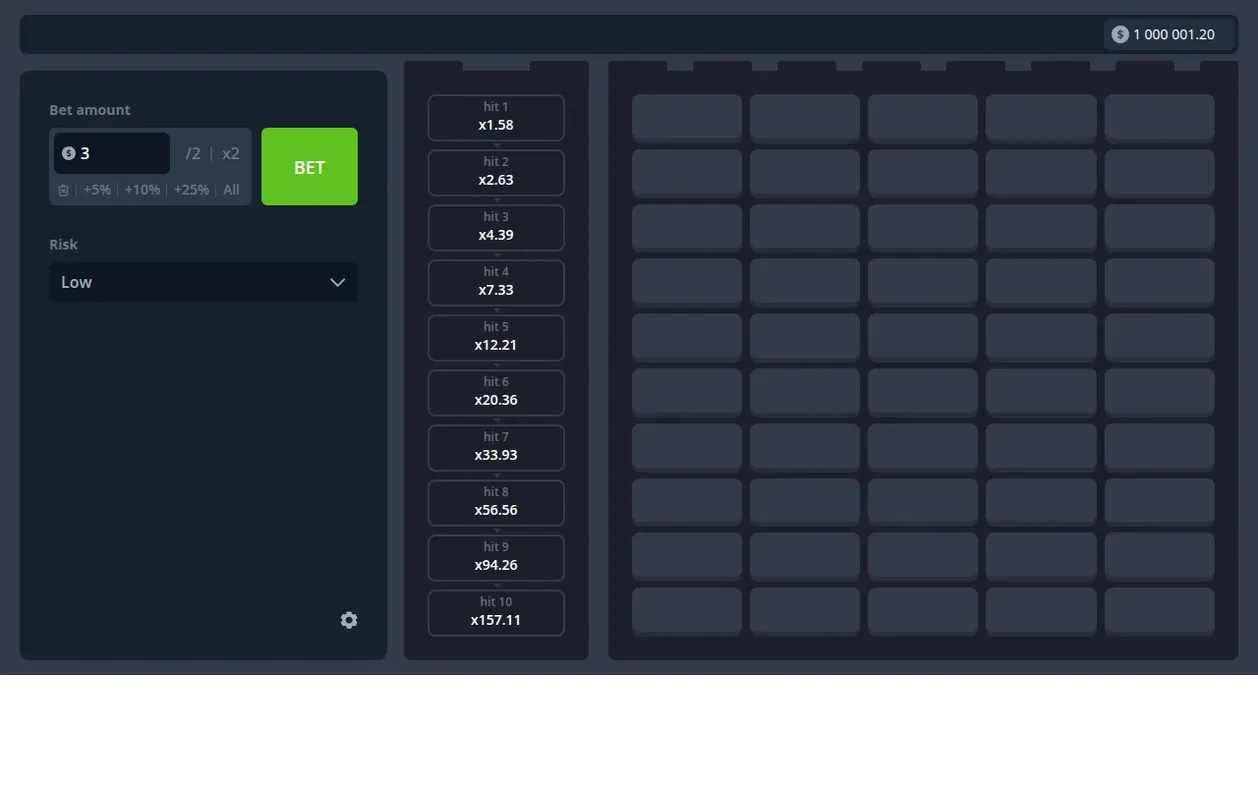
Low risk idle grid with empty tiles, ladder showing hit 1 x1.58 up to hit 10 x157.11, balance 1 000 001.20.

Classic risk

The gentlest of the four settings. Each row hides a single padlock among four safe cells, so roughly four picks in five survive, and the ladder moves slowly from x1.18 at the first row to x8.84 at the tenth. The result is a long, shallow climb where the bankable amount grows in small steps.

Low risk

Choosing Low swaps in a steeper ladder than Classic, opening at x1.58 on the first row and topping out at x157.11 on the tenth. The safe-to-padlock split per row was never captured for this mode, so only the multiplier curve is documented; the rest of the climb behaves as the board presents it.

Medium risk

Medium is the setting the game boots into, and returning the selector to it restores the default build: two safe cells against three padlocks in every row, a 40% survival chance per pick. The ladder reloads from x2.37 at the first row to x9059.9 at the tenth, steeper than Classic or Low from the opening step.

High risk

High swaps in the steepest ladder of the four, starting at x4.75 on the first row and escalating to x9277343.75 at the tenth. That final rung is nominal only: the 20000 USD max-win cap on a single round puts it out of reach at any stake, so the payable ceiling lands far below the printed figure.

Device compatibility

Autoplay option
No

Who made this game

InOut Games

InOut Games is a B2B studio that builds crash and instant-win titles for online casino operators, most visibly through its long-running Chicken Road series. The catalogue mirrored here runs past fifty entries, and crash games make up the bulk of it, with instant-win and a smaller run of video slots and table variants alongside. Titles are built on HTML5, localised into more than fifteen languages, and reach operators through aggregation partners such as Hub88, Slotegrator and Infingame. The site and games are operated by IOGr B.V., which holds an Anjouan B2B licence covering platform and back-end services for licensed operators.

Bets and stakes

Minimum bet
0.12
Maximum bet
200.00
Per-round bet count
1

Available bonuses

Buy-a-bonusNo

Verdict

Highlights

  • One build holds four distinct ladders, from Classic's gentle 4:1 board to a brutal High climb.
  • Every step is a genuine cash-out call: the whole running total rides on the next pick, and one padlock forfeits it all.

What could be better

  • The flat 20000 USD cap makes the top High rungs unreachable at any bet size, and trims Medium rungs at bigger stakes.
  • There is no provably fair check, no bet history and no autoplay, so every session runs on trust and manual clicks.

Common questions about the game

  1. How does a round of Tower play out after I place my bet?

    A board of ten rows, five cells each, opens from the top. You tap one cell per row: a green gem banks you up the ladder and lifts your cash-out value, a padlock ends everything. The amber button below the bet always shows the exact amount you can take after the last completed row, and you can press it at any point or push on toward hit 10.

  2. What happens if I open a cell that hides a padlock?

    The round is over on the spot, and everything you had accumulated above the stake is forfeited — only the bet itself stays lost. All fifty cells then flip face-up at once, revealing every padlock on the board, including the rows you never reached. That full forfeit is what makes each further pick a genuine gamble.

  3. What are my actual chances of surviving a row in each risk mode?

    They swing widely by mode. Medium, which the game loads with, packs three padlocks into each row, so a random pick gets through 40% of the time. Classic carries just one padlock per row, an 80% survival chance. The build never states the Low or High splits, so their ladders are the only published guide for those two.

  4. How high do the multipliers climb in each of the four risk modes?

    Classic creeps from 1.18x on hit 1 to 8.84x at the top. Low reaches 157.11x. Medium, the default, climbs to 9 059.9x, and High prints a nominal 9 277 343.75x on hit 10. Steeper ladders always mean fewer safe cells per row, so the big numbers and the long odds arrive together.

  5. Is the 9 277 343.75x at the top of High risk actually payable?

    No single round can pay it. A flat 20 000 USD cap applies regardless of mode or stake, which equals about 166 666.67x at the 0.12 minimum bet and only 100x at the 200 maximum. Any rung above that line is simply paid as 20 000 USD, so the printed summit is a ladder figure, not a reachable payout.

  6. What are the minimum and maximum bets in Tower?

    The accepted range runs from 0.12 USD to 200 USD, and the input rejects anything outside it with a red on-screen message. Beside the field you get /2 and x2 buttons, +5%, +10% and +25% boosts, an All button that stakes the whole balance, and a trash icon to clear the value.

  7. What is the RTP of Tower, and who released it?

    Tower lists a 95.00% RTP. It comes from InOut Games and dates back to September 2021. One quirk worth knowing: the game never prints the RTP anywhere — its help popup only lists the bet limits and the 20 000 USD win cap — so the figure is one you check here rather than on screen.

  8. Does Tower have autoplay, a provably fair panel, or bet history?

    None of the three exists in this build. The whole settings surface is a single gear-icon popup that holds the four how-to steps, the bet limits, the win cap and a sound toggle. If you want fairness verification or a record of past rounds, you will not find them here.

Casinos offering this game

  • 1XBET

    Confirming your email and mobile number unlocks a $12 credit before any deposit is needed. Wagering runs at 25 times the amount within seven days, counted fully on slots. Whatever remains once that's cleared can be withdrawn, though payouts from it stop at $60 total.

    Visit casino
  • 18+
  • We may earn a commission from the casino links listed above.
  • Treat this as fun rather than a source of income, and set yourself a spending limit beforehand.
Date published
26/10/2026
Updated
26/10/2026