Hi-Lo
Crash

Hi-Lo Free Demo: Try the Turbo Games Card Game

by Turbo Games

RTP
95.00%
Risk level
—
Top win potential
—
Reels
—
Paylines and ways
—
Release date
04/04/2023

The Multiplier Climbs, the Exit Call Is Yours

Open Hi-Lo and the table looks stripped back: one card on green felt, a seven-slot history row, two guesses. The telling detail is what is missing. Read the whole rules booklet and no maximum multiplier appears anywhere; the only ceiling printed in this build is monetary, Max Profit $10000, stated twice on screen. The x999999 figure belongs to the storefront, not the felt. So the Progressive Multiplier plays as a ladder with a cash exit rather than a promised peak, and the real decision in every round is when to hit Cash Out.

Hi-Lo: A Crash Ladder Dealt One Card at a Time

A card table running a crash round

Hi-Lo, released by Turbo Games in April 2023, takes its Cards theme literally: a green felt table, cream card faces, one reveal in the centre of the screen. Underneath sits the machinery you know from crash titles — a Progressive Multiplier that grows only while you stay in, and a Cash Out that answers to your timing alone. Two recorded details show how deliberately the two identities are joined. Each direction pill carries its multiplier printed above it before you commit, and the small refresh icon on the card panel lets you randomise the starting card for free, but only before a bet exists. The relationship between those two allowances is the point. Every variable the build can disclose, it discloses up front; what remains unknown is narrowed to a single event, the rank of the next card. That is a crash round with its curve dealt face up, and it sets the terms for everything that follows.
Where your configuration ends and the build's begins

Round dimensionWhat you configureWhat the build fixes
Stake$0.1 to $100 in steps; cancel is free before the first card$10,000 Max Profit per round
Opening cardFree random re-roll before Place BetDeal order once the round starts
Each stepHigher, Lower, or Equal on a 2 or AceOdds computed from the card showing
ExitCash Out after any correct guessA wrong guess ends the round

The ladder is uneven because the deck is

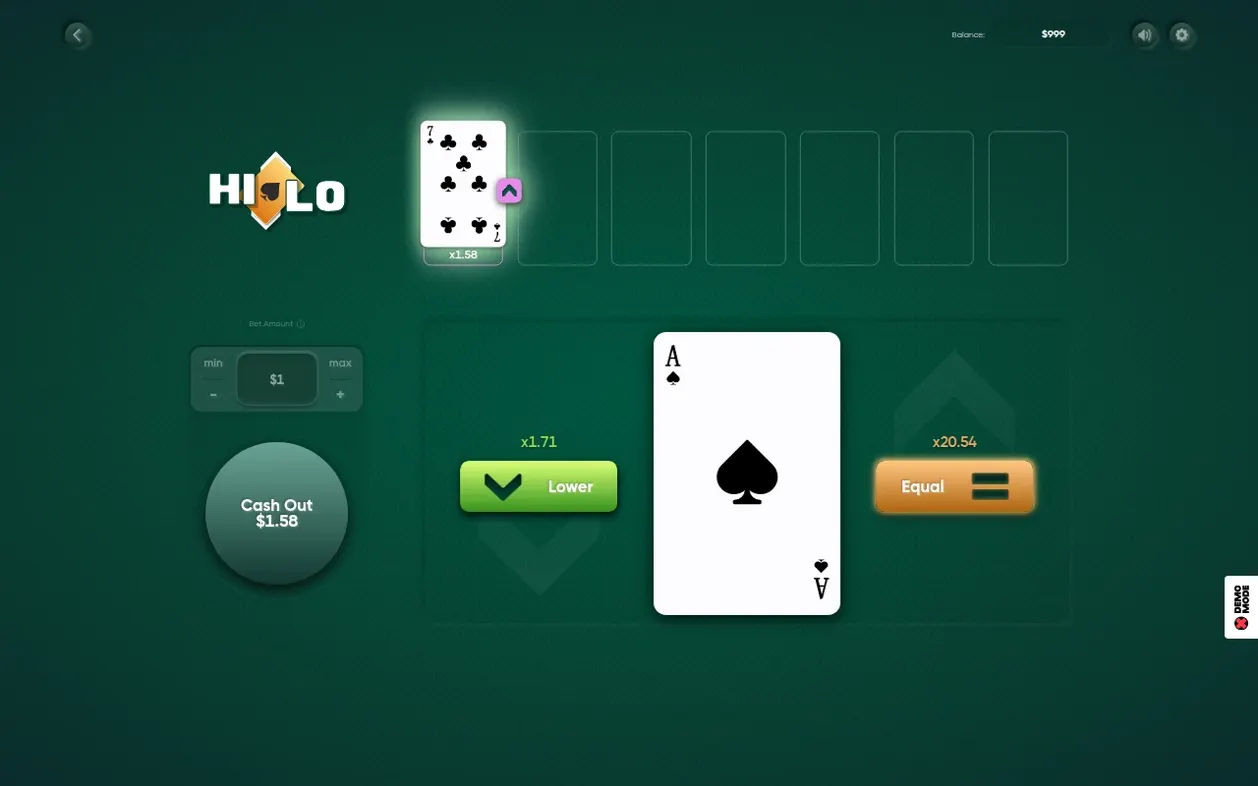
One captured round shows the machinery mid-run and repays a close reading. From a $1 stake, the history badge on the seven of clubs already reads x1.58 and the live card is the ace of spades. Because nothing ranks above an ace, the build replaces Higher with Equal, priced at x20.54, while Lower sits at x1.71; the Cash Out button, meanwhile, offers $1.58. Two things follow. The Progressive Multiplier is an absolute state, recomputed from the odds of whichever card is live, not a running product of the steps taken to reach it. And the slope of the ladder belongs to the deck: middling cards post modest rungs, extreme ranks concentrate the volatility, and the Equal option turns the two ends of the deck into the riskiest, most visible choices on the table. Pace is also yours. Nothing advances without a click, so the tension of the round lives entirely in the gap between the exit value printed on the Cash Out button and the odds printed above the next guess.

Ace of Spades showing, Lower x1.71 and Equal x20.54 options, Cash Out $1.58 button active, $999 balance.

The build's own numbers over the storefront's

For readers weighing ceilings and volatility, the honest figures are the ones this build prints about itself, and they deserve quoting exactly. The rules booklet states an RTP of 95.0% in a dedicated sentence, even though the public Turbo Games storefront advertises 97% for the same title; where the two disagree, the in-build figure is the one on record here. The betting limits are stated twice inside the build itself — a Limits dialog and the max stepper's tooltip both give a $0.1 minimum bet, a $100 maximum bet and a $10,000 Max Profit — which makes the ceiling one of the best-corroborated numbers in the package. No multiplier ceiling is printed anywhere. The booklet's five sections contain no max-multiplier entry, so the storefront's talk of multipliers up to x999999 stays unconfirmed for this build. The cap that actually governs play is monetary: $10,000 per round, not a figure on the ladder.

A calm table, an asymmetric voice

Presentation serves the same restraint. The table is a static frontal layout, flat vector controls over textured green felt; numeral cards are deliberately plain while jacks, queens and kings arrive as ornate court illustrations, so the deck's own visual rhythm echoes the ladder's unevenness. Feedback is one-sided, though. A successful cash-out summons a ceremonial win banner, while a lost round simply resets the board to Place Bet with no screen of its own — the build marks the moment you leave and goes quiet when the streak breaks, which quietly shapes how a session feels. A few details remain unresolved. Across every captured frame only black suits were dealt, so red-suit rendering stays unobserved; the history row offers seven slots while the rules promise unlimited reveals, and what happens past seven was never seen. None of that changes the core transaction. Everything here is configurable, everything is disclosed, and the one thing withheld is the rank of the next card — which is where the heartbeat of a crash round lives anyway.

Step-by-step guide to playing

Turbo Games builds Hi-Lo around one card on the felt and a call you repeat at your own pace: will the next card rank higher or lower than the one showing? Every correct guess feeds the Progressive Multiplier, and after each reveal the same choice comes back: take the Cash Out or ask for another card.

  1. Set your stake, then deal

    Set the Bet Amount, or leave the default in place. Before committing, the refresh icon on the card panel can swap the starting card for a random one. Click Place Bet: the first card is dealt face up, the stake leaves your balance at that moment, and the Lower and Higher options light up with their multipliers.

  2. Call each card as it comes

    Click Lower or Higher to call the next card; on a 2 or an Ace, Equal takes the place of the impossible side. A correct call shifts the card into the history row, lifts the multiplier and turns the main button into Cash Out, so you can collect or keep calling. A wrong call ends the round there.

Symbol payouts

Reel symbol Role
Numeral Cards (2-10)Other
Face Cards (Jack, Queen, King)Other
AceOther

Bankroll management and volatility explained

Hi-Lo gives you three decisions to time: how much to commit before the first reveal, whether to take Equal on 2 or Ace, and when to stop collecting. The evidence supports consequences, not a winning method: a wrong call can erase an uncollected ladder, while Cancel only works before any card is shown.

  1. Set the stake before the first reveal

    Bet Amount can be stepped between $0.10 and $100, or left at the default. The stake is debited when the first card is revealed, so the amount you commit fixes both the loss on a failed call and the base for any later Cash Out. Cancel was verified free only before any card is shown; no mid-round stake edit is documented.

  2. Take Equal only on 2 or Ace

    When the live card is 2 or Ace, Equal replaces the impossible side. On an Ace the screen offered Lower x1.71 beside Equal x20.54, so the decision is between the lower-printed side and a much larger single-step award. It still only advances the ladder if the next card matches; a wrong call ends the round with no partial payout.

  3. Decide when the ladder is enough

    After one correct guess, the main button becomes Cash Out with the collectable amount printed on it. Taking that money settles the round; balance deltas and the My bets table matched the printed amount. Choosing another call leaves the value exposed, since one incorrect reveal ends the round with no partial award. No multiplier ceiling is printed; the evidenced monetary ceiling is Max Profit $10000.

Game modes

Every Hi-Lo round moves through a fixed chain of table states, from idle felt to settled outcome. The transitions below — what shows before a bet, what flips when the first card lands, and how a streak turns into money or nothing — belong to a single mechanism.

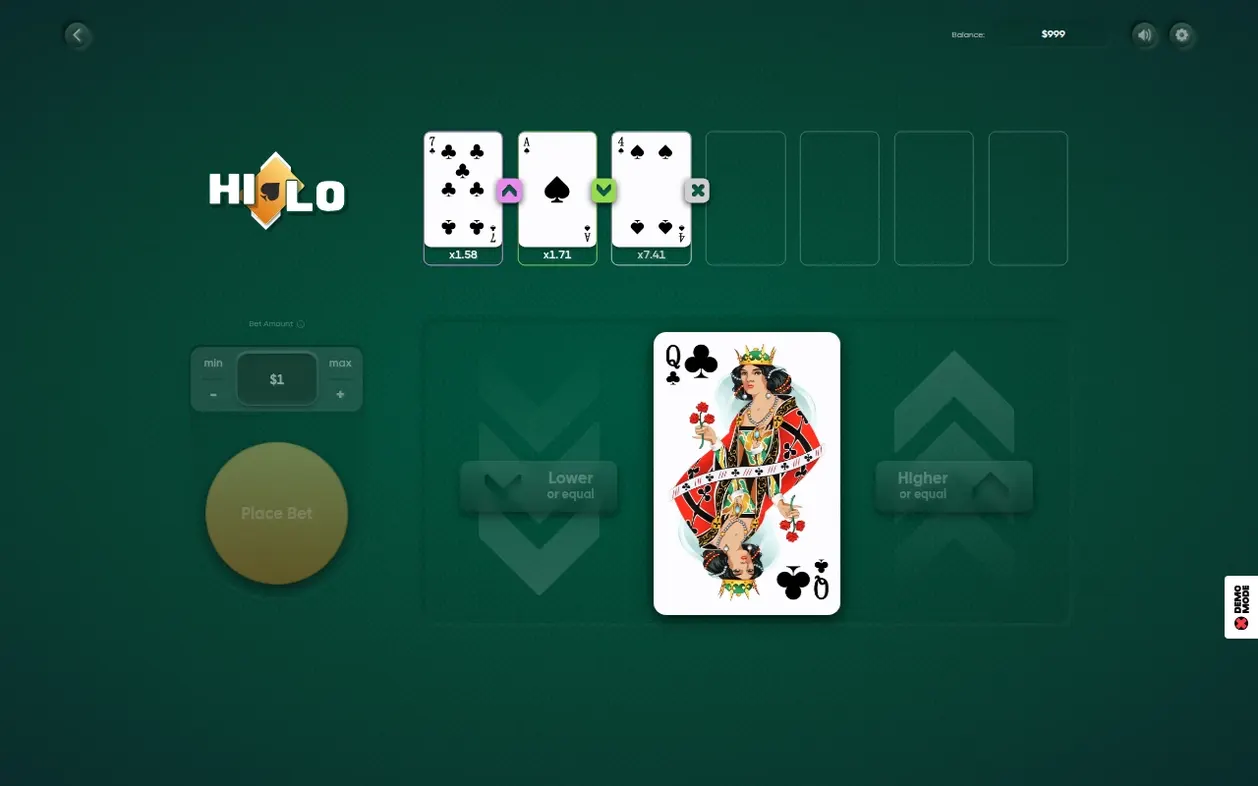
History row shows 7, Ace, 4 of Spades with a grey X badge marking the loss; Queen of Clubs now live, Place Bet dulled gold.

Base Game

At rest the table shows a starting card and two faint direction chevrons with no numbers. The stake leaves your balance at the first reveal, not at Place Bet, and the pills brighten with multipliers computed from the live card. Each correct call shifts the card into the history row and rewrites the Cash Out value afresh; on a 2 or an Ace the impossible direction swaps out for Equal. Cash out whenever, or press on — one wrong call ends the round, forfeits the build-up, and resets the table.

Theme and setting

  1. Cards

Device compatibility

Autoplay option
No

Features

  • Cash Out
  • Progressive Multiplier

Who made this game

Turbo Games

Turbo Games is a Tallinn-based studio, operated by Turbodev OÜ, that builds crash and instant-win titles rather than reel slots. Every round runs on a seed-based provably fair system, so a player can verify an outcome after it settles, and many games let you set the risk directly through grid size, mine count or a win-chance slider. The catalogue documented here dates from 2021 onward and leans heavily on crash formats, from Crash X and Mines to the Vortex series. The studio holds a Malta Gaming Authority Recognition Notice as a B2B supplier.

Bets and stakes

Minimum bet
0.10
Maximum bet
100.00
Currency of bets
USD
Per-round bet count
1

Verdict

Highlights

  • The exact multiplier for each call is shown before you commit, so you always know what the next step pays.
  • You can cash out after any correct guess, and cancel is free until the first card of the round is revealed.

What could be better

  • The rules print RTP 95.0% while the storefront advertises 97%, and the lower in-build figure governs.
  • Provably fair verification is absent from this build, and the rules booklet confirms no multiplier ceiling anywhere.

Common questions about the game

  1. What is the Equal option in Hi-Lo and when does it appear?

    Equal appears only when the live card is a 2 or an Ace, the two ranks where one direction is impossible. It replaces the missing guess and pays far more: an Ace might offer Lower at x1.71 beside Equal at x20.54. If the opening card does not suit you, the refresh icon swaps it for a random one before you commit your stake.

  2. How does the multiplier grow if I keep guessing correctly?

    Every correct call moves the revealed card into the history row and raises the multiplier on the Cash Out button, which pays your stake times whatever value is showing when you click. The figures above Lower, Higher or Equal are the single-guess odds for the current card, so safer guesses add less. Hi-Lo states no multiplier ceiling; the hard cap is a maximum profit of $10,000 per round.

Casinos offering this game

  • 1XBET

    Confirming your email and mobile number unlocks a $12 credit before any deposit is needed. Wagering runs at 25 times the amount within seven days, counted fully on slots. Whatever remains once that's cleared can be withdrawn, though payouts from it stop at $60 total.

    Visit casino
  • 18+
  • We may earn a commission from the casino links listed above.
  • Treat this as fun rather than a source of income, and set yourself a spending limit beforehand.

Explore more titles from this studio

Date published
30/10/2026
Updated
02/11/2026