Mines
Crash

Mines Free Demo: Play the Crash Game

by Turbo Games

RTP
94.71%
Risk level
—
Top win potential
4,940,285x
Reels
—
Paylines and ways
—
Release date
05/2021

The First Tile Commits, Each Gem Reopens the Exit

Some crash games stretch the wait before the climb; Mines by Turbo Games stretches the climb itself into a dozen small decisions. Each round on the 5x5 grid is a sequence of states, not a single rising line: pick a mine count, start, then open tiles one at a time while the Prize Ladder overhead lights its next step. The telling detail is when the money moves. Starting a round leaves the balance untouched and the button reading Cancel, so that phase costs nothing; the stake leaves only when the first tile turns over, and from there Cash Out stays live after every gem. The moment-to-moment feel shifts with the settings too: at 20 mines the ladder leaps in a few steps, while at 3 it creeps. Turbo Games lists a 94.71 RTP, and the exit decision repeats every tile rather than once per round.

Mines Review: An Honest Interface With Quiet Limits

An Interface That Reports Its Own State

Mines by Turbo Games dresses the crash formula as minesweeper: a 5x5 grid of dark tiles, a Prize Ladder across the top, and little else competing for attention. What stands out after a few rounds is how faithfully that surface reports the round underneath it. The primary button does not merely recolor; it changes its word, walking from Start Game to Cancel to Cash Out as the bet moves from placed to cancellable to live. The details panel beside the grid reads like an instrument cluster, giving Gems left, Mine risk and Opened tiles as plain numbers rather than dials. Even the tiles carry state in two channels at once: a revealed gem is a different object from a bomb, not just a different tint, and the reached ladder step is marked by position as well as highlight. In a game where every decision is a reading of the current state before the next click, that redundancy is the real design work.
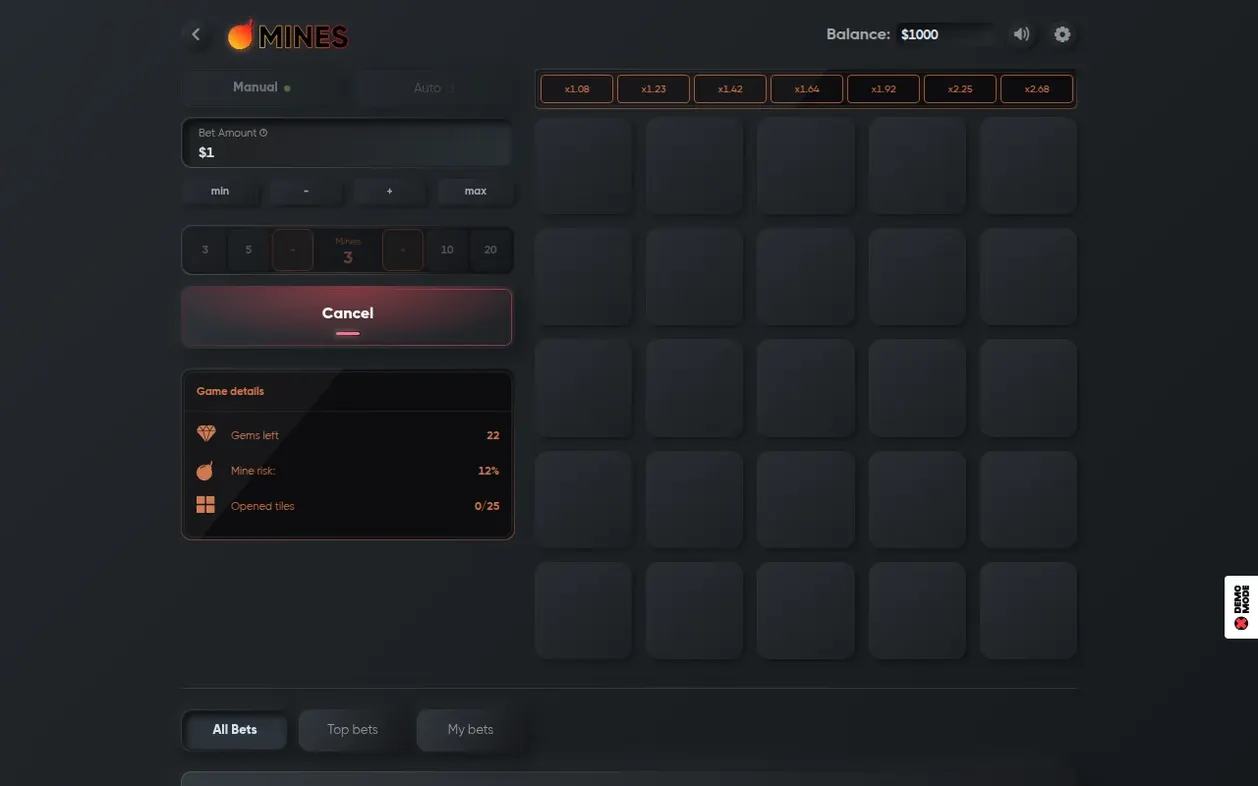
Bet panel shows Cancel active, 3 mines chosen, ladder x1.08 to x2.68, 25 tiles still hidden.

Where the Rules and the Balance Agree

  • The stake is not debited at Start Game; the balance drops only when the first tile opens, exactly matching the printed Cancel rule.
  • A measured $1 round at x1.64 offered Cash Out $1.64 and paid it, confirming the printed formula of multiplier times bet, rounded down.
  • The Mine risk percentage in the panel is the rules' own formula, mines divided by unopened tiles, kept current as a live number.
  • The documented top RTP of 95.30% against the 94.71% floor is tied in the rules to cashing out at x1.03, the ladder's first step.
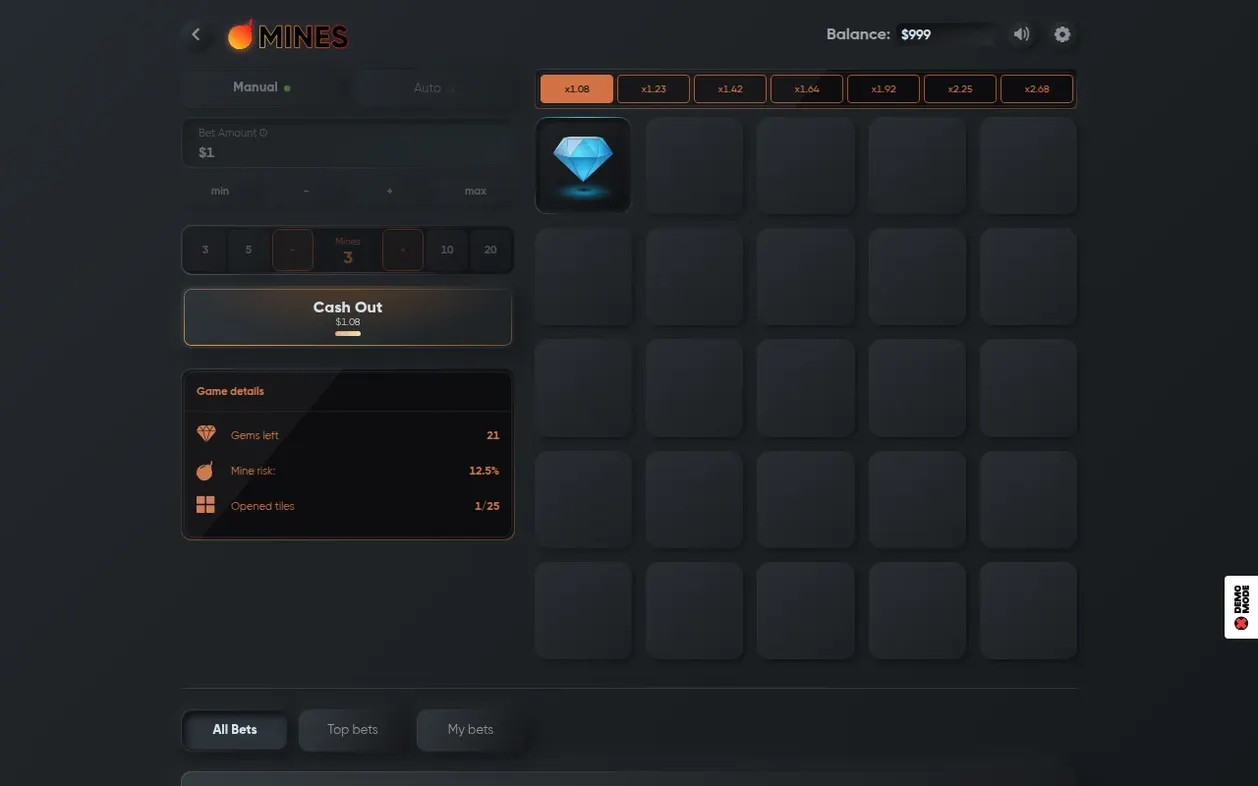
One diamond revealed on a 3-mine grid, Cash Out offers $1.08, mine risk 12.5%, 1 of 25 tiles opened.

Where the Openness Thins

The candor thins precisely where the numbers grow largest. The rules concede a ceiling of x4940285, reachable only with 13 mines and 12 successively opened tiles, a configuration the visible ladder never advertises on the board. More decisive is the fine print beside it: a $10,000 operator cap on profit, stated in the Limits dialog and explicitly deferred to by the rules themselves. The arithmetic ceiling is real, then, but the payout ceiling sits far below it, and nothing on screen reconciles the two. The remaining gap is verification. The provider's storefront describes provably fair rounds, yet the in-game rules booklet contains no section on checking a round seed, so the one claim about integrity is the one the build does not let you test. None of this makes the readouts unreliable during play; it simply marks the boundary where shown behavior ends and printed promises take over.

Step-by-step guide to playing

Mines by Turbo Games is a 5x5 board of hidden tiles where every revealed gem climbs the Prize Ladder and every bomb ends the round. The goal is to decide after each tile whether to keep going or press Cash Out before a mine appears.

  1. Set your bet and mine count

    Enter a value in the Bet Amount field using the min, -, + or max buttons, then pick a mine count with the presets 3, 5, 10 or 20, or use the stepper to cover the full 2 to 24 range.

  2. Start the round and open a tile

    Press Start Game to arm the board; the button switches to Cancel because your stake is not taken yet. Tap any tile to open it: the bet is debited at that moment and the tile either shows a gem or a bomb.

  3. Keep opening tiles or Cash Out

    Each gem raises the multiplier on the Prize Ladder, while the Mine risk % and Opened tiles n/25 counters update in the Game details table. Press Cash Out at any point to take your stake times the current multiplier, rounded down to two decimals.

  4. Handle the end of the round

    If you hit a mine the round ends and the bet is lost. If you uncover every gem on the board, Cash Out fires automatically at the top of the ladder. You can then start a new round with the same or a new setup.

Bankroll management and volatility explained

Two documented decisions in Mines carry different kinds of consequence. The Bet Amount is a pre-round setting whose payout potential runs into an operator cap; the Cash Out point is re-decided after every gem and is the only choice the printed rules tie to the return figure. Neither influences where the mines sit.

  1. Choosing where to Cash Out

    Cash Out is available from the first gem onward and is re-decided after every tile, the one choice repeated within a round. The rules tie its timing to return: RTP runs from a printed 94.71% minimum to a 95.30% maximum, stated as achieved by cashing out at x1.03. Where other exit points fall inside that band is not documented; RTP remains a long-run average, not a promise for any single round.

  2. Sizing the bet against the payout cap

    Bet Amount is set before Start Game and stays revisable between rounds. Returns scale with stake times multiplier, but the operator caps the payout; this build's Limits dialog prints 10,000. Beyond the stake where that cap binds, a larger bet adds exposure without raising the most a round can pay. The rules defer to the Limits section, so the figure is operator-specific.

In-game screenshots

A single red circle sits alone on a solid black background, a minimal loading or transition graphic.
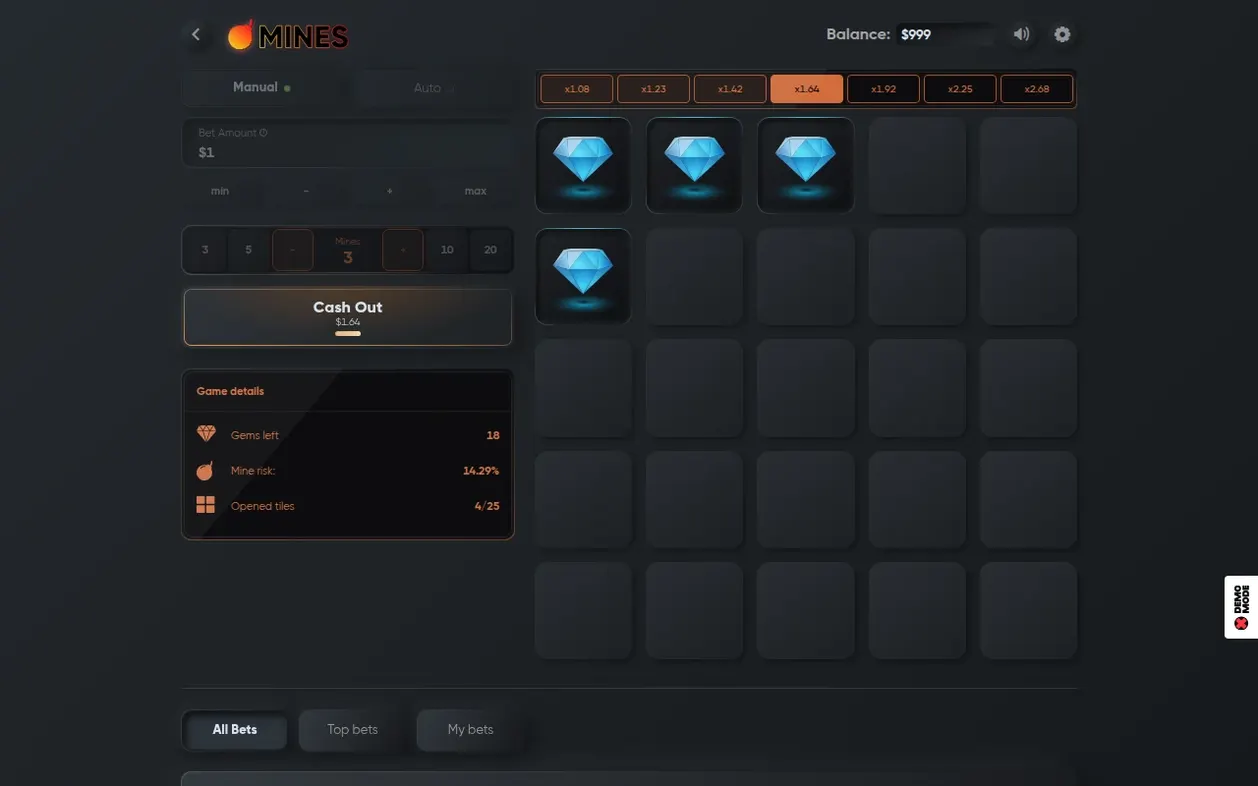
Four diamonds revealed in a row on a 3-mine board, Cash Out ready at $1.64 with 14.29% mine risk showing.
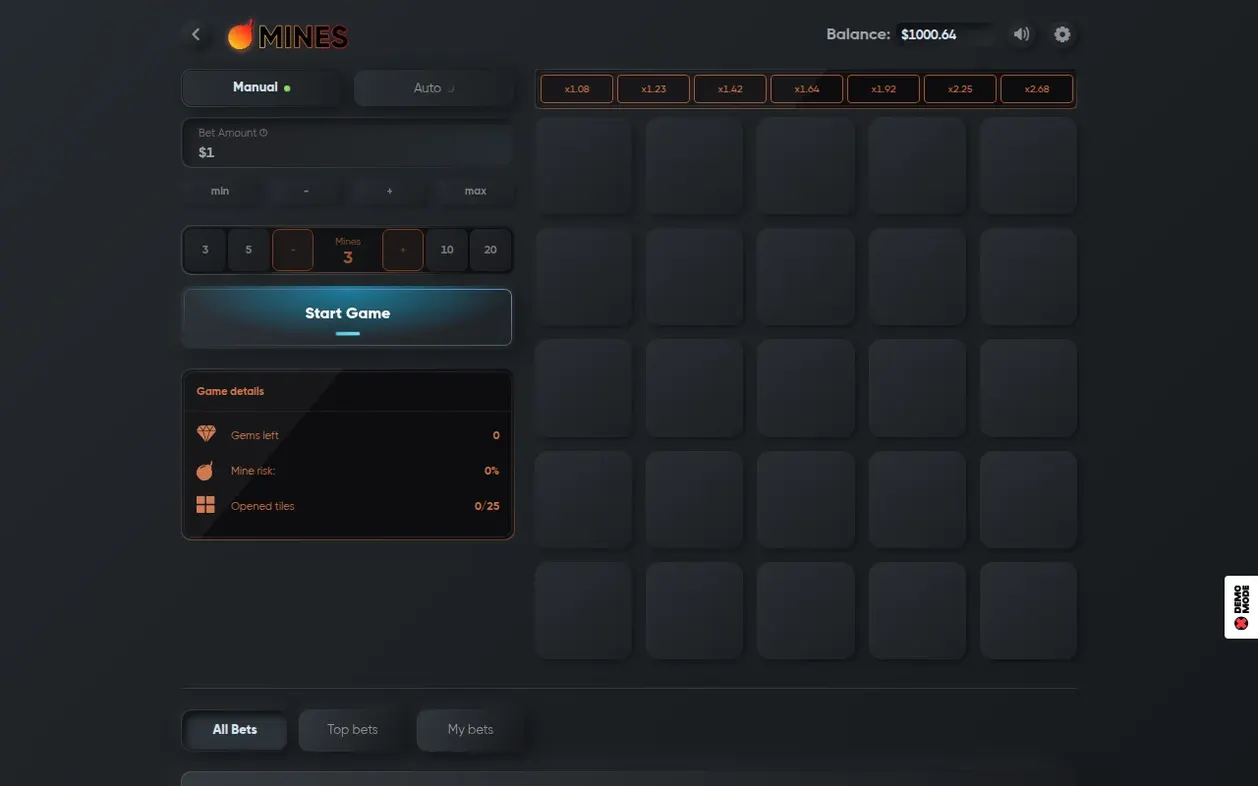
Grid reset and ready to play: 3 mines selected, Start Game lit up, balance sitting at $1000.64 after a win.
×
A single red circle sits alone on a solid black background, a minimal loading or transition graphic.
‹1 / 3›
×
Four diamonds revealed in a row on a 3-mine board, Cash Out ready at $1.64 with 14.29% mine risk showing.
‹2 / 3›
×
Grid reset and ready to play: 3 mines selected, Start Game lit up, balance sitting at $1000.64 after a win.
‹3 / 3›

Game modes

Three controls shape every round of Mines: how it is run, how it repeats, and how much danger it carries. Each governs a different part of the flow, but all three meet at the same point, the moment the first tile opens and the stake is committed.

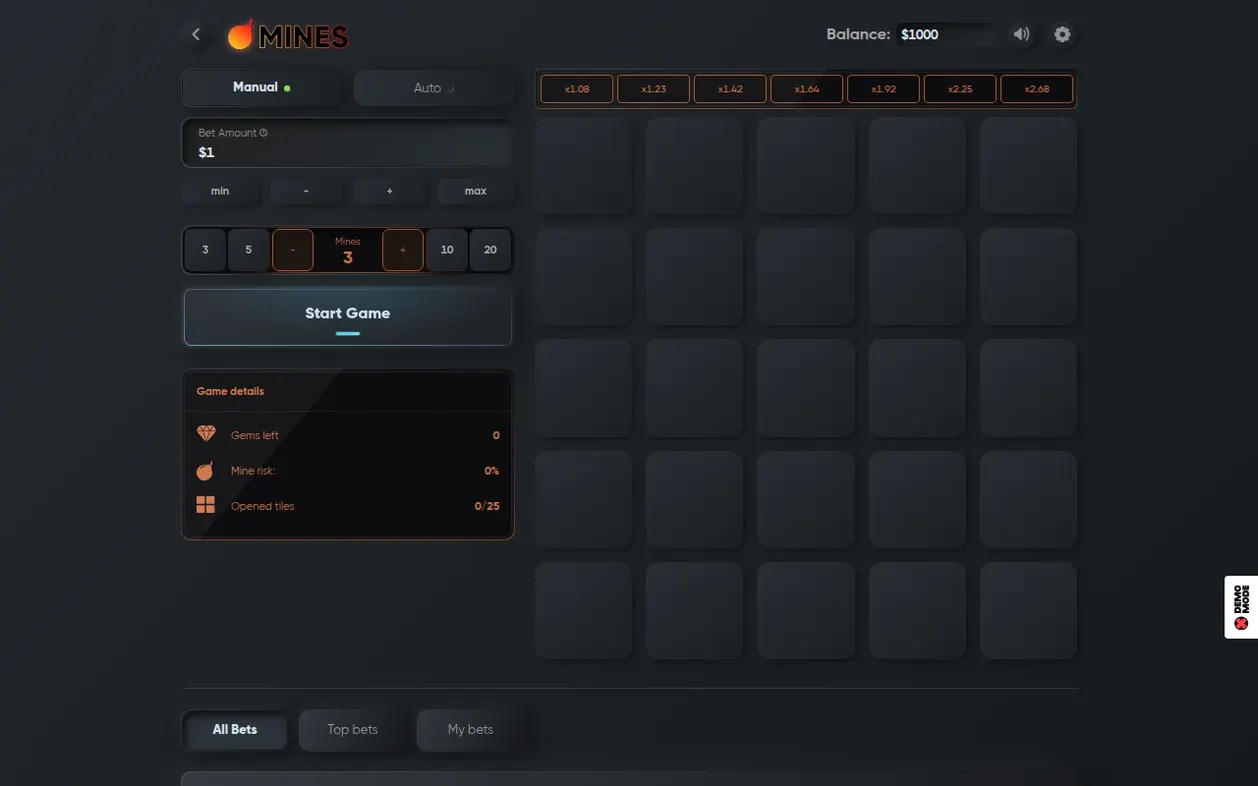
Start Game screen with 3 mines set, bet $1, mine risk 0%, 0 of 25 tiles opened, balance $1000.

Manual round

Before any tile opens, the stake has not left the balance; the button has simply changed to Cancel. The debit lands the moment the first tile is revealed, which is why the bet can still be withdrawn up to that point. Each gem found lifts the multiplier, and Cash Out becomes an option from the first gem onward.

Autoplay

The Auto tab replaces the manual back-and-forth with a preset run: a round count that stays open-ended if left blank, tiles chosen in advance, and rules for what happens on a win or a loss, either resetting the stake or raising it by a set percentage. A Stop at any Win toggle can cut the run short.

Mine count risk selector

Between 2 and 24 mines, with presets at 3, 5, 10 and 20, this choice reshapes the multiplier ladder itself. At 3 mines the ladder climbs from x1.08 to x2.18k; at 20 mines it starts at x4.75 and reaches x50.47k. The trade-off is a higher chance of hitting a mine on each open tile.

Theme and setting

  1. Gems

Device compatibility

Autoplay option
Yes

Features

  • Cash Out
  • Prize Ladder

Who made this game

Turbo Games

Turbo Games is a Tallinn-based studio, operated by Turbodev OÜ, that builds crash and instant-win titles rather than reel slots. Every round runs on a seed-based provably fair system, so a player can verify an outcome after it settles, and many games let you set the risk directly through grid size, mine count or a win-chance slider. The catalogue documented here dates from 2021 onward and leans heavily on crash formats, from Crash X and Mines to the Vortex series. The studio holds a Malta Gaming Authority Recognition Notice as a B2B supplier.

Bets and stakes

Minimum bet
0.10
Maximum bet
100.00
Per-round bet count
1

Available bonuses

Buy-a-bonusNo

Verdict

Highlights

  • A 2-to-24 mine selector redraws the ladder at every tier, so one build spans gentle grinding and brutal variance.
  • Nothing is debited until the first tile is revealed, so a misconfigured round costs nothing to abandon.

What could be better

  • With profit capped at $10,000 by the operator, the advertised x4,940,285 multiplier is decorative, not attainable.
  • Provably fair play is promoted on the storefront, but the rules booklet inside the build has no seed check.

Common questions about the game

  1. When is my bet actually taken from the balance in Mines?

    The stake leaves your balance only when you open the first tile, not at Start Game. Until that first pick you can still cancel the round and keep the full amount; once a tile is opened, the bet is committed and hitting a mine loses it.

  2. How does the multiplier ladder in Mines work?

    Each revealed gem moves you one step up a Prize Ladder whose multipliers depend on your chosen mine count. Cash Out is available from the very first gem onward, and the payout equals the current multiplier times your bet, rounded down to two decimals.

  3. What is the highest possible win in Mines by Turbo Games?

    The maximum win multiplier is x4940285, reachable only with a 13-mine setup and twelve consecutive safe tiles. The ladder shown on screen caps out far lower for most mine counts, and the operator may also limit total profit to $10,000 regardless of the multiplier.

  4. What RTP does Mines have and how do I get the best rate?

    RTP ranges from a minimum of 94.71% up to 95.30%, with the top figure achieved only by cashing out at the first available multiplier of x1.03. Holding out for more gems progressively lowers the effective return, so longer runs trade RTP for bigger potential payouts.

  5. What settings can I change before starting a round in Mines?

    You set your bet between $0.10 and $100 and pick a mine count from 2 to 24 using presets of 3, 5, 10 or 20 plus a stepper. A Manual or Autoplay mode is available, with autoplay offering round limits, stop-on-win and stake adjustment rules.

Casinos offering this game

  • 1XBET

    Confirming your email and mobile number unlocks a $12 credit before any deposit is needed. Wagering runs at 25 times the amount within seven days, counted fully on slots. Whatever remains once that's cleared can be withdrawn, though payouts from it stop at $60 total.

    Visit casino
  • 18+
  • We may earn a commission from the casino links listed above.
  • Treat this as fun rather than a source of income, and set yourself a spending limit beforehand.

You might also like

Date published
28/09/2026