Mines
Crash

Mines Free Demo: Play the Game Here

by PoggiPlay

RTP
98.00%
Risk level
Medium
Top win potential
10,000x
Reels
—
Paylines and ways
—
Release date
17/04/2026

Where the Multiplier Moves Only When You Do

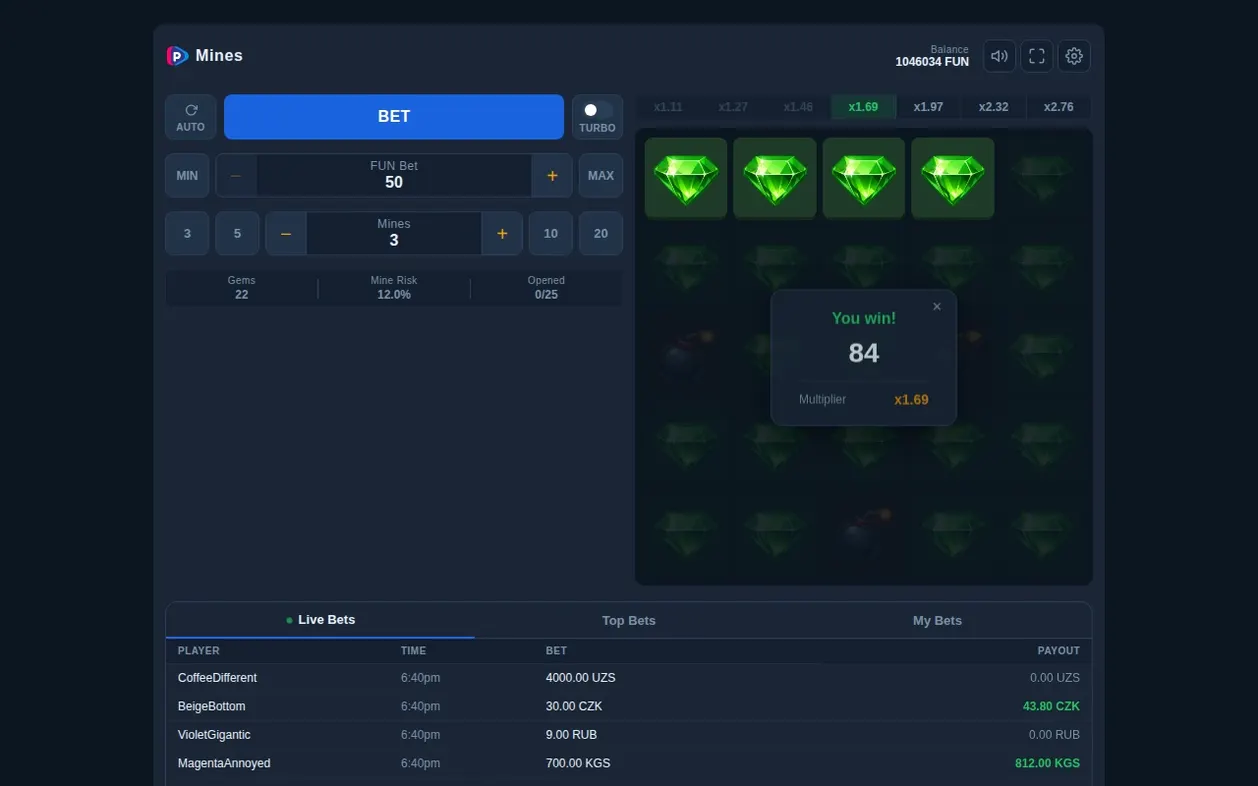
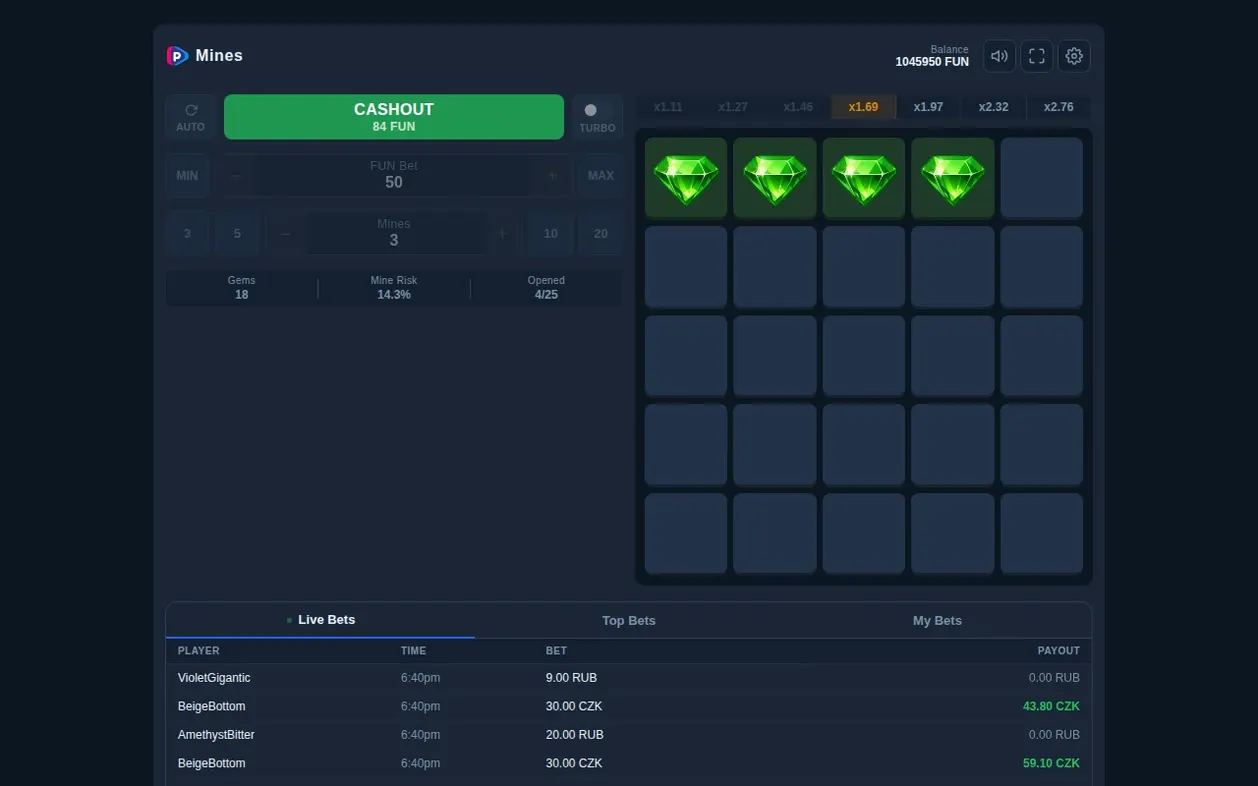
PoggiPlay's Mines moves the timing pressure off the curve and onto the board: the multiplier never climbs on its own, it steps up only when a tile is opened, and the same pick that raises it also raises the Mine Risk counter beside the grid, 12.0% at the start of a three-mine round and 14.3% after four gems. Before that chain begins there is a short grace, since the bet can still be cancelled until the first tile is turned; from then on the exits are the green CASHOUT button or a mine that reveals all 25 tiles in red. The arithmetic stays exact throughout, multiplier times bet rounded down, and a 50-credit round collected at x1.69 paid precisely 84. Medium volatility and a 98.00% RTP describe the frame; the round itself is a sequence of decisions, each one closing the door behind it.

PoggiPlay Mines: a round that only moves when the player does

A multiplier without a clock

Anyone arriving at PoggiPlay's Mines from crash titles will notice the missing element first: there is no clock. In a crash round the multiplier climbs on its own and the only question is when to step off; here the ladder above the 5x5 board does not move until a tile is opened, and it waits patiently whenever the player does nothing. The dressing is Adventure and exploration filtered through Gems: green faceted stones, black bombs with lit fuses, very dark navy behind everything. The provider labels the build Instant Win, which is mechanically accurate, yet the underlying bargain is the familiar one: a rising multiplier, a rising chance of losing the stake, one button that banks what is on the table. What changes is who owns the tempo. Every pause is free, every step is voluntary, and the tension a crash curve compresses into seconds is stretched here across as many discrete decisions as the player elects to take. That unhurried structure organises almost everything else about this build.
One round, three endings, one irreversible click

A single round is a short chain of states, and the build is explicit about which one it is in: the action button changes its word as well as its color, from BET to CASHOUT, with CANCEL offered only until the first tile is opened. That first click is the point of no return, the one moment after which the committed stake cannot be withdrawn. From there each gem advances the ladder a step while the counters re-price the position live: Gems left, Opened tiles, and a Mine Risk percentage computed from mines remaining against tiles still closed. A round ends in exactly three ways. The player banks the current amount, a mine is revealed and the board turns over in red, or the game cashes out by itself, either because every gem has been found or because a payout limit has intervened. One recorded round shows the arithmetic plainly: 50 FUN at 3 mines, four gems, out at x1.69 for 84 FUN, the balance moving by exactly bet times multiplier. Nothing in the chain runs on a timer; the position would survive an hour's pause between picks.

Choosing mines is choosing how long a round can last

Documented setting3 mines20 mines
Steps to clear the board225
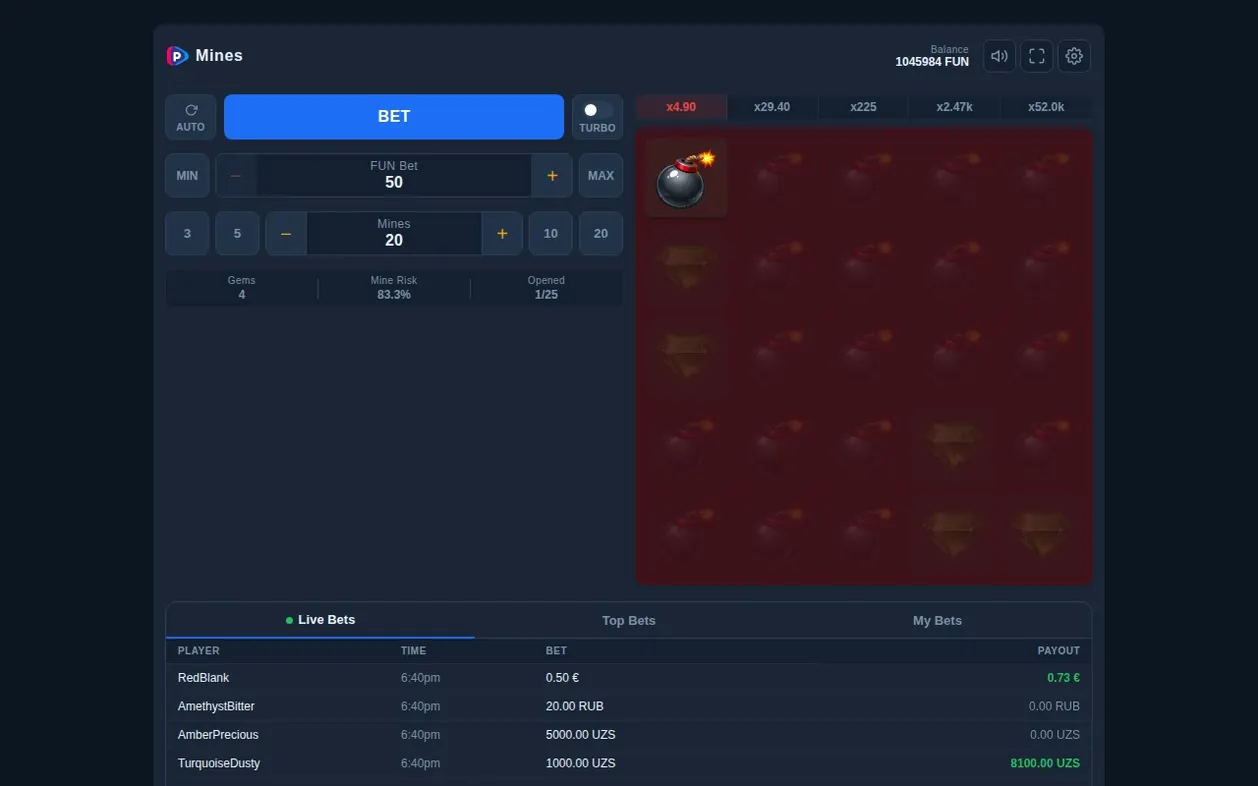
First ladder stepx1.11x4.90
Mine Risk at the first pick12.0%83.3%
Top printed stepx2.25kx52.0k

Where the rules end the round before the ladder does

The printed ladder describes futures the rules do not always allow to happen. On the 20-mine board the strip climbs to a printed top step of x52.0k, yet the Game Limits panel caps any round at a Max Multiplier of x10000, and the rules state that whenever the potential win on the next pick would exceed the payout limits the game cashes out automatically. The same panel fixes a Max Win of 150000 FUN, an absolute ceiling rather than a bet multiple: it printed identically at 50 FUN and at 100000 FUN, the documented minimum and maximum stakes. The provider's own page adds a Max Exposure figure of 15 000 dollars that matches neither the credit arithmetic observed here nor any published conversion, so it remains an unresolved business figure rather than a playable limit. In temporal terms, a run can be terminated mid-decision, in the gap between one tile and the next, by a ceiling the player may not have been watching. The published RTP of 98.00% and the Medium volatility rating, three of five bars on the provider's page though never printed in the build, describe the long run of many such rounds rather than any single one.

What happens to time between rounds

  • Auto Bet outsources the loop: tiles are pre-selected, then series of 10, 20, 50 or 100 bets run unattended.
  • Advanced auto settings re-arm after each result: Reset or Increase by a percentage on win or loss, plus Stop on Profit and Stop on Loss.
  • Turbo shortens only the reveal animation; the states themselves, and the decisions between them, are untouched.
  • Hotkeys compress the action loop further: Space bets, cashes out and stops auto, while R opens a random tile.
  • Live Bets, Top Bets and My Bets sit under the board as an archive of past rounds, with Top Bets covering the last 24 hours.
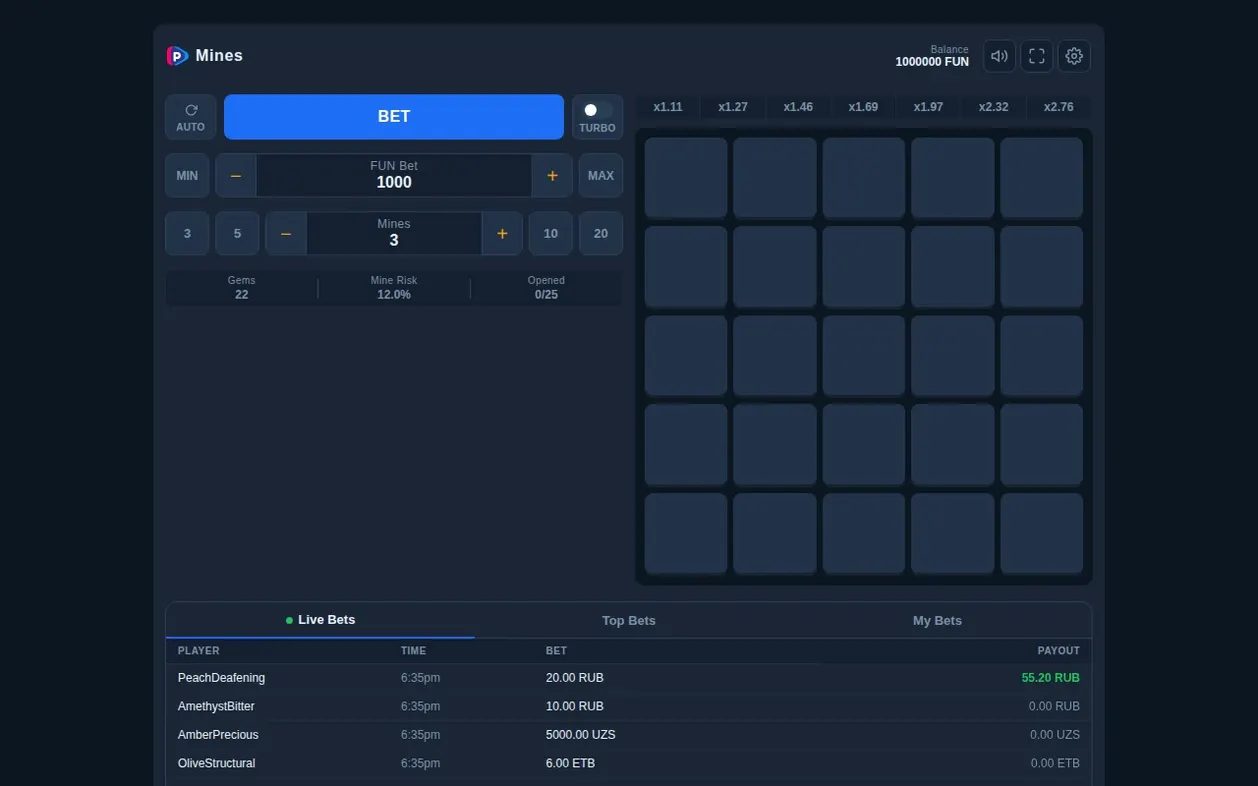
Idle Mines board with 3 mines set, bet 1000 FUN, ladder from x1.11 to x2.76, 0/25 opened

Step-by-step guide to playing

Mines by PoggiPlay leaves the reels aside and works on a 5x5 board of covered tiles. Under them sit gems and the mines you have chosen to seed, and the job is to find the gems, since each one lifts the payout multiplier on the stake. After every safe reveal the same decision returns: take what the CASHOUT button offers, or open another tile for the next multiplier.

  1. Set the stake

    Adjust the bet on its row of controls: MIN and MAX send the value to either limit, minus and plus move it gradually. This amount is the base every multiplier of the round will scale.

  2. Choose mines and press BET

    Set how many mines hide on the board with the 3, 5, 10 or 20 presets, or take any count from 2 to 24 with minus and plus. Pressing BET commits the stake and starts the round; until the first tile turns, CANCEL still withdraws it.

  3. Open tiles for gems

    Reveal tiles one at a time. Each gem highlights the next step of the multiplier ladder, pushes up the amount shown on the CASHOUT button and refreshes the Gems, Mine Risk and Opened counters. The loop continues until you stop it.

  4. Cash out or push on

    Press CASHOUT at any point to settle: the win panel reports the amount and the multiplier behind it. If an opened tile hides a mine instead, the stake is lost and the whole board turns over, every gem and every mine shown in red.

Bankroll management and volatility explained

Mines concentrates its decisions into three unequal levers, and each binds at a different moment: the mine count is fixed for the round once the opening tile is revealed, the question of stopping returns after every gem, and the stake runs into an absolute win ceiling that no ladder step can pass.

  1. The mine count locks in with the first tile

    It is picked alongside the stake, and once the first tile opens the CANCEL window is gone; the rules document no way to alter the count from then on. What it settles is the starting Mine Risk, captured at 12.0% with 3 mines and 83.3% with 20, so the risk profile chosen at setup is the one the round runs on. Other counts were not recorded.

  2. Each additional pick accepts a higher Mine Risk

    After every gem the same fork returns: CASHOUT pays multiplier times bet, rounded down to two decimals; opening one more tile trades that for the next step at a higher Mine Risk, since the mines stay and the unopened tiles shrink, 12.0% becoming 14.3% after four opens in the record. The formula counts only mines and opened tiles, so pick history changes nothing beyond it.

  3. The stake decides where the win cap bites

    Chosen at setup, the stake scales every payout linearly, but the demo prints a Max Win of 150000 FUN, identical at a bet of 50 and at 100000. So the larger the stake, the lower the multiplier at which the automatic cashout at the payout limit ends the round, and the more of a steep ladder stays display-only. No FUN-to-currency rate is printed, so this is verified in credits only.

In-game screenshots

A mine hits on the first tile with 20 mines chosen, turning the board red at 83.3% mine risk and x4.90
Cashing out four green gems nets a win of 84 FUN at the x1.69 multiplier step, bet 50 FUN with 3 mines
Mid-round with four gems revealed, the button now reads CASHOUT 84 FUN as mine risk climbs to 14.3%
×
A mine hits on the first tile with 20 mines chosen, turning the board red at 83.3% mine risk and x4.90
‹1 / 3›
×
Cashing out four green gems nets a win of 84 FUN at the x1.69 multiplier step, bet 50 FUN with 3 mines
‹2 / 3›
×
Mid-round with four gems revealed, the button now reads CASHOUT 84 FUN as mine risk climbs to 14.3%
‹3 / 3›

Game modes

Everything on the Mines board hangs off one picking round: you set the risk, open tiles and decide when to leave. Two further systems sit on top of that round, one replaying it automatically and one cutting it short at a ceiling, so each entry below is best read as a step in the same sequence.

Mines loading screen with bomb and lit fuse beside a green gem, PoggiPlay logo, progress bar at 83%

Manual Round

The whole game builds on this loop. First you pick the mine count, anywhere from 2 to 24 with presets at 3, 5, 10 and 20, then place the bet and press BET; CANCEL can still take the stake back until the first tile opens. Every gem revealed raises the multiplier on the ladder, and CASHOUT pays multiplier times bet, while a mine ends the round at a loss.

Auto Bet

This mode depends on the manual setup rather than replacing it: you pre-mark the tiles you want opened, choose how many bets to run (presets 10, 20, 50, 100) and the panel repeats the round on its own. The Advanced toggle adds On Win and On Loss behaviour, either resetting the stake or raising it by a percentage, plus Stop on Profit and Stop on Loss limits.

Automatic cashout at the payout limit

Two conditions close a round before you touch anything: all gems are found, or the next pick would push the potential win past the payout limits. Because that ceiling is absolute, the ladder can display steps above the declared x10000 that no round will ever reach, so the visible top of the ladder is not the real end of a session.

Theme and setting

  1. Adventure and exploration
  2. Gems

Device compatibility

Autoplay option
Yes

Who made this game

PoggiPlay

PoggiPlay is a video slot studio headquartered in Yerevan, Armenia, whose documented releases date from 2021. It works strictly on the B2B side of the industry, building games rather than running casinos and supplying operators through aggregation partners, including a distribution agreement with Slotegrator announced in 2024.

Its slots are built around original concepts wrapped in a distinct visual style, a backstory and recognisable characters, and the releases documented in this catalogue range across farm, horror, space and seasonal themes, with a growing thread of crash games alongside. Everything is built in HTML5 for desktop and mobile, with the game math and random number generation reported as certified by BMM Testlabs.

Bets and stakes

Per-round bet count
1

Available bonuses

Buy-a-bonusNo

Verdict

Highlights

  • Rules print 98.00% RTP in plain text, so the return figure is read straight from the build, not from a lobby listing.
  • Mine Risk updates live after every opened tile, so each cashout call is made against a visible percentage, not a hunch.
  • Mines adjust from 2 to 24; presets alone swing opening Mine Risk from 12.0% to 83.3%, so the player sets the swing.

What could be better

  • The 20-mine ladder shows x52.0k, but a x10000 max multiplier forces auto-cashout long before those steps can land.
  • Bet limits exist only as FUN credits with no printed conversion rate, so real-money stake sizing is left unclear.

Common questions about the game

  1. What is the maximum win in PoggiPlay's Mines?

    A round tops out at a x10000 multiplier or a flat 150,000-credit win, whichever comes first. The ladder can print higher steps, up to x52.0k with 20 mines, but those stay out of reach: the game cashes out automatically once the next pick would pass the payout limit, and the 150,000 ceiling holds at any bet size.

  2. How does the number of mines change a round in Mines?

    You pick between 2 and 24 mines before betting, with quick presets at 3, 5, 10 and 20. More mines mean a steeper ladder: the first gem pays x1.11 with 3 mines but x4.90 with 20. A live Mine Risk counter prints the chance that the next tile hides a bomb, updating as tiles open.

  3. How does Auto Bet work in Mines?

    The AUTO panel runs full Auto Bet series: you pre-select the tiles to open, choose 10, 20, 50 or 100 bets and press Start Autobet. An Advanced toggle adds On Win and On Loss actions, either reset or raise by a percentage, plus Stop on Profit and Stop on Loss amounts. Pressing Space stops the series at any point.

  4. What RTP and volatility does Mines have?

    The Rules panel states an RTP of 98.00%, the same figure PoggiPlay lists on its game page. Volatility is not named inside the build itself; the provider rates it Medium, three bars out of five, which fits how sharply the payout ladder steepens as you raise the mine count.

Casinos offering this game

  • 1XBET

    Confirming your email and mobile number unlocks a $12 credit before any deposit is needed. Wagering runs at 25 times the amount within seven days, counted fully on slots. Whatever remains once that's cleared can be withdrawn, though payouts from it stop at $60 total.

    Visit casino
  • 18+
  • We may earn a commission from the casino links listed above.
  • Treat this as fun rather than a source of income, and set yourself a spending limit beforehand.

You might also like

Date published
08/09/2026